22 858 pregnancies achieved over 21 years

Services

Doctors

All
Preimplantation Genetic Testing (PGT)

Preimplantation Genetic Testing (PGT)

  • PGD

    Pre-implantation genetic diagnosis (PGD) refers to genetic profiling of embryos created through IVF prior to the transfer into the patient’s uterus. During PGD the embryos are screened for a number of specific genetic disorders, so as to exclude the possibility of selected embryos having these particular abnormalities.

    PGD enables patients with a chronic disease in their family history to avoid passing it on to their children. A specialist may recommend PGD if patients have a family history of severe genetic diseases or previous miscarriages due to genetic disorders.

    PGS

    The term preimplantation genetic screening (PGS) is used to denote procedures that do not look for a specific disease but use PGD techniques to identify embryos at risk. PGS involves checking the embryos chromosomes for common abnormalities. Chromosomal abnormalities are a major cause of miscarriages and the failure of embryos to implant. They can also cause such serious medical conditions as Down’s syndrome.

    PGS is normally recommended for:

    • older patients ( women over 35 years old);
    • patients with a history of recurrent miscarriages;
    • patients with a history of unsuccessful IVF cycles after the embryo transfer stage;
    • patients with a family history of chromosomal diseases.
Noninvasive prenatal testing (NIPT)

Noninvasive prenatal testing (NIPT)

  • NIPT helps to learn a lot about the baby during the first trimester. This is the most progressive way to diagnose chromosomal disorders and other abnormalities, utilized in all developed countries in the world.

    The testing analyzes small fragments of DNA that are circulating in a pregnant woman’s blood.

    The testing is recommended when:

    • The woman is older than 35 years old;
    • Possible genetic abnormalities suspicions after the ultrasound;
    • The pregnancy achieved with the use of IVF or other VRT 
    • The risk of genetic abnormalities detected during the biochemical screening;
    • Genetic abnormalities detected in other children’s DNA;
    • A history of stillbirth;
    • Premature labor or recurrent miscarriage;
    • Unexplained infertility.

    The key advantages of NIPT include its high accuracy and safety. The possibility of diagnostic mistake is only 0.01%. 

    For this testing, the mother’s venous blood is used. The blood taking procedure is completely safe for both the baby, and the mother.

    One more advantage is that the testing can be performed very early in the pregnancy – in the 9th week. 

    Diagnostic capabilities of the testing

    The testing can detect the following diseases and abnormalities:

    • Down syndrome;
    • Edwards syndrome;
    • Patau syndrome;
    • Turner syndrome;
    • Klinefelter syndrome;
    • Triple X syndrome;
    • Double Y syndrome.

    While analyzing the fetus’ DNA, it is possible to identify its sex.

    Even though NIPT is a high-accuracy method of diagnosis, it is, nevertheless, a screening test. Which means that should any abnormalities be detected during the testing, they still must be confirmed by an invasive test, such as fetal karyotyping. 

    The testing is not performed:

    • Earlier then the 9th week of pregnancy;
    • If selective (multifetal) reduction has been performed;
    • In cases of multifetal pregnancies with three or more fetuses;
    • When the baby is carried by a surrogate mother;
    • When the pregnancy is achieved by means of IVF with the use of donor oocytes.

    If you would like to get more information about this method of diagnosis, please, contact the clinic by phone or via the online inquiry form.

IVF after 40 years

IVF after 40 years

  • IVF after 40 years

    Pregnancy after 40 is a fairly rare occurrence even if you try to conceive naturally. IVF can be a possible solution to this problem for women over 40.

    The ability to get pregnant, gestate and give birth to a child is determined by the age of woman planning to become a mother.

    How to get pregnant over 40?

    For a woman after 40 years a possibility of the natural conception and normal pregnancy decreases year after year. 

    Modern ART and IVF come to help patients over 40. Such methods are actively used in AltraVita center. Such methods are actively used in AltraVita center. To determine the possibility of getting pregnant with her own eggs for a woman over 40, ovarian reserve assessment is required.

    For this reason the following options are used:

    • Determination of AMH (anti mullerian hormone) - allows you to predict the chances of conception, although it does not affect fertility itself and decreases with age;;
    • FSH (follicle-stimulating hormone) - the ovarian reserve means sufficient if there is a value of 10 mIU / ml and below;;
    • Antral follicles count — the follicles are counted during ultrasound examination.

    At this age IVF is often performed in natural cycle, because a large number of eggs cannot be obtained during a stimulation.

IVF: minimal stimulation protocol

IVF: minimal stimulation protocol

  • Included services

    • Ovarian stimulation
    • Medication for stimulation of ovulation:  Clostilbegyt 50 mg – 1 box, gonadotropins (Puregon, Gonal, Menopour) 600 IU, Diphereline 0.1 – 2 ampules, Cetrotide – 1 ampule.
    • Folliculometry
    • Hormonal monitoring of stimulation
    • Consultations of reproductive endocrinologist
    • Transvaginal ovarian puncture
    • General anesthesia
    • 2-3 hours stay in day hospital with medical monitoring
    • Identification and evaluation of oocytes’ maturity
    • Preparation of sperm for fertilization using two samples of ejaculate
    • Cultivation of embryos until 5-6 day of development
    • Freezing of embryos

    Excluded services

    • Additional medicaments
    • Emergency care in case of complications 
    • Assisted hatching
    • Biopsy of embryo
    • Any type of PGD/PGS
    • ICSI/IMSI fertilization
    • Additional consultations of specialists
    • Embryo transfer
    • Storage of frozen embryos
    • Usage and thawing of donor gametes 
IVF

IVF

  • Whom is IVF treatment suitable?

    • Women who have been diagnosed with unexplained infertility
    • Women with fallopian tubes obstruction
    • When other techniques such as fertility medication or intrauterine insemination (IUI) have not been successful
    • When a limited number of oocytes are available
    • Male partner has serious fertility problems
    • Couples are using donated eggs or their own frozen eggs in their treatment
    • Couples are using preimplantation genetic screening to avoid passing on a genetic condition to the child

    IVF Treatment steps

    • Consultation with reproductive endocrinologist; selection of the individual stimulation protocol.
    • Ovulation induction according to the protocol chosen in order to ensure a higher number of eggs.
    • Monitoring of the hormonal stimulation under ultrasound. The number of matured eggs and quality of uterine lining will be checked.
    • Egg retrieval is performed by gynecologist under general anesthesia. The whole procedure takes 10-20 minutes.
    • Sperm collection, analysis and preparation. Semen is prepared for fertilisation by removing inactive cells and seminal fluid in a process called sperm washing.
    • Fertilisation using ICSI or IMSI methods.
    • Cultivation of embryos. The produced embryos are being cultivated in special incubators for 5-6 days. Their development is closely monitored by experienced embryologists. If necessary, PGS or PGD can be performed to select embryos free from genetic diseases. 
    • Embryo transfer is a painless transfer of the best embryo into the woman’s uterus. Spare embryos will be cryopreserved by vitrification.

    Frozen embryo transfer is one of ART techniques. Many couples choose to try frozen embryo transfer program after a successful IVF attempt to have a second baby.

Embryology lab

Embryology lab

  • At the first IVF cycle, conception occurs in half of patients. Following the second attempt, the efficiency rate increases up to 60.5%, and after the third attempt, to 70.5%.

    • Polarizing microscopy
    • intracytoplasmic morphologically selected sperm injection (IMSI)
    • Embryos’ cultivation carried out in the atmosphere low in reactive oxygen species
    • Vitrification of oocytes and embryos

    Polarizing microscopy

    New in infertility treatment is the use of polarizing microscopy, for which the innovative Oosight View is applied. The device, combining optical and computer technology, allows you to see an egg from the inside and identify possible violations in its structure.

    Thus, it allows you to choose the healthiest eggs. Besides, polarizing microscopy is also in demand during the ICSI procedure, since it avoids such a phenomenon as damage to the spindle of the egg cell.

    IMSI

    In case of fertilization by ICSI, it is important to choose the best sperm. If a sperm with chromosomal pathologies is selected, then the probability of genetic disorders in the embryo becomes high. But the use of a conventional microscope does not allow a detailed examination of the structure of the sperm. Therefore, we use a new approach in the treatment of infertility - special high-contrast video microscopy.

    Damage to DNA can occur due to the presence of apoptotic vesicles in the sperm, which are formed under the influence of reactive oxygen species. This device provides an opportunity to see apoptotic vesicles and thereby reject low-quality sperms.

    This device is actively used for the IMSI procedure. Thanks to it, the chances of positive results of in vitro fertilization increase several times, especially in case of male factor infertility.

    Embryos’ cultivation carried out in the atmosphere low in reactive oxygen species

    In the atmosphere, the oxygen concentration is much higher than its concentration in human blood - 20% against 5%. As a result, the number of active oxygen species in embryos increases, which entails damage to cell membranes and DNA fragmentation. It has become possible to avoid such a negative phenomenon thanks to the use of modern incubators. In such incubators, the natural environment of the female body is completely imitated, respectively, the oxygen level in them is optimally low.

    This allows to significantly increase the embryo survival rates and increase the percentage of those which managed to develop to the blastocyst stage. In addition, the use of such technology has a positive effect on implantation of embryos.

    Vitrification of oocytes and embryos

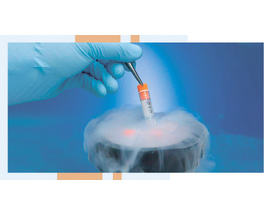
    Vitrification of embryos - ultrafast freezing - allows to save the received embryos but not those used for transfer during the IVF program. Vitrification of embryos makes the transfer as much effective as in the fresh program, but without burdening the body with stimulation drugs.

    Vitrification of embryos represents a new approach in the treatment of infertility. This term means ultrafast freezing, due to which almost all embryos survive after cryopreservation - 98%.

    A specialized device that allows to transfer embryos into the uterine cavity. Our clinic has at its disposal this unique device. With its help, it is possible to transfer embryos into the uterine cavity so carefully that the probability of losing at least one embryo during the procedure is completely eliminated.

ICSI/IMSI

ICSI/IMSI

  • Intracytoplasmic Morphological Sperm Injection (IMSI) is similar to ICSI with the one exception: a doctor before microinjection using a multiple magnification of the microscope - about 6,000 times - carefully examines the sperm, chooses the most "healthy", without pathological changes. Only after that doctor takes a sperm for its introduction into the egg.

Altravita Clinic occupies leading positions in the field of reproductive medicine, the treatment of female and male infertility, cytogenetic and molecular-genetic studies.

or
AltraVita IVF
AltraVita
arrow_upward